Someone recently asked me:
“How do I make and save my first $100,000?”
My first response wasn’t an investment recommendation.
It was a question.
What do you want the $100,000 to be?
That distinction matters more than it sounds.
- You could earn $100,000 this year without saving much of it.
- You might accumulate $100,000 in cash.
- Your investment accounts could reach $100,000.
Perhaps you’re trying to reach $100,000 in net worth.
A business owner may want to build an enterprise with meaningful value.
Those are different financial objectives.
So before asking how to reach $100,000, decide what reaching it actually means.
The Short Answer

To build your first $100,000, you generally need to create a consistent gap between what comes in and what goes out, then direct that gap toward the appropriate savings, debt reduction or investment vehicle for your goal.
Three variables matter enormously:
- How much you can contribute.
- How consistently you contribute.
- How much time you give the money.
If investing is involved, returns add another variable, but investment returns should never be presented as guaranteed.
Why $100,000 Feels So Difficult
The number looks enormous when viewed as one lump sum.
Break it into contributions and the conversation changes.
- At $500 per month, you're contributing $6,000 annually.
- At $1,000 per month, that's $12,000.
- A monthly contribution of $2,000 equals $24,000 per year.
Those examples intentionally exclude investment returns.
Why?
Because contribution is the part you can control most directly.
Markets don’t take instructions from us.
Your behavior does.
Start With the Big Numbers

Personal finance conversations can become strangely obsessed with tiny purchases.
Look at your largest financial decisions first.
- Housing.
- Transportation.
- Debt payments.
- Insurance.
- Recurring family obligations.
Then examine income.
A $7 subscription deserves less attention than a compensation gap worth $20,000 per year.
This is particularly important for established professional women.
At some point, financial progress cannot depend entirely on finding another expense to cut.
Your Earning Power Matters
Women building wealth should examine both sides of the equation.
What leaves?
And what comes in?
Consider whether your compensation reflects your current value.
Look at opportunities for advancement.
Understand what comparable roles pay.
If you own a business, know whether your pricing and margins actually support the company you’re trying to build.
Your expertise has economic value.
Treating income growth as part of financial planning is not greed.
It’s mathematics.
Watch What Happens After a Raise

Income increases create an opportunity.
They also create temptation.
A raise makes previously expensive things feel normal very quickly.
Lifestyle improvement isn’t inherently bad.
You worked for the money.
Enjoy some of it.
The danger is allowing every additional dollar to become permanently committed.
Before your next raise lands, decide what portion belongs to today and what portion belongs to your future.
Define Your $100,000
Finish this sentence:
I want $100,000 in __________ because __________.
The second blank may be more important than the first.
Why?
Because the purpose influences where the money belongs.
Money for a near term home purchase should not automatically be treated the same way as retirement money with decades before it is needed.
A cash reserve serves a different purpose from an investment portfolio.
Purpose comes before product.
What If You Have Debt?
Debt doesn’t automatically disqualify you from building wealth.
But you need to understand it.
- Look at interest rates.
- Cash flow.
- Emergency savings.
- Employer retirement benefits.
- Recurring family obligations.
Whether the debt is growing or shrinking.
Most importantly, understand why the balance exists.
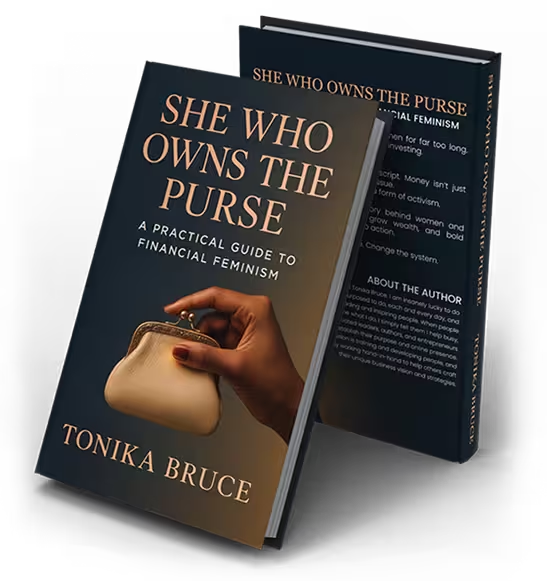
That’s why I created the Debt Autopsy™ inside Financial Feminism.
Whether the debt is growing or shrinking.
Most importantly, understand why the balance exists.
What If You're Starting Later?

A woman in her 40s or 50s doesn’t have the same timeline as someone who began at 22.
That doesn’t mean she should give up.
It means the strategy needs to reflect reality.
You may be in higher earning years.
Your children may require less financial support.
A mortgage may be further along.
Your professional expertise may command more money.
Or perhaps you’re rebuilding and none of those things are true.
Start with your actual position.
Comparison doesn’t improve your balance sheet.
Action does.
Stability Can Help You Build Faster
There’s a reason this conversation connects to Episode 15 of Financial Feminism.
Stability is valuable.
Predictable income gives you something to plan around.
Benefits may reduce certain risks.
A mature career can create earning leverage.
Instead of viewing stability as the finish line, use it as infrastructure.
Ask:
What can I build because my life is stable enough to build it?
That question turns comfort into strategy.
Five Years From Now Is Coming Anyway

Here’s the question I want professional women asking:
If I continue doing exactly what I’m doing financially, where will I be five years from now?
Not where you hope you’ll be.
Where your current behavior is taking you.
If you like the answer, continue.
If you don’t, change something while you have the luxury of changing it deliberately.
You don’t need a financial crisis to justify making a better decision.
Your First Move
Don’t make ten.
Choose one.
Increase an automatic contribution.
Research your market compensation.
Redirect part of your next raise.
Review one major recurring expense.
Understand one investment account you already own.
Use the Financial Freedom Scorecard.
Complete the Debt Autopsy™ if debt keeps interfering with your progress.
Then come talk about what you discovered.
Building Wealth Should Change Your Options

The purpose of $100,000 isn’t to win a financial beauty contest.
It’s what the money can eventually make possible.
Greater resilience.
More choices.
Less dependence on the next paycheck.
A business opportunity.
Retirement flexibility.
A home.
The ability to leave something.
Your reason will be personal.
That’s why I don’t want women simply chasing impressive numbers.
Build the number that supports the life you’re trying to create.
And when you reach it?
Build the next thing.
Listen to Episode 15
Stability Is a Strategy: Comfort Can Cost You
This week we’re asking one question:
What are you building?
You don’t need an impressive answer.
You just need an honest one.