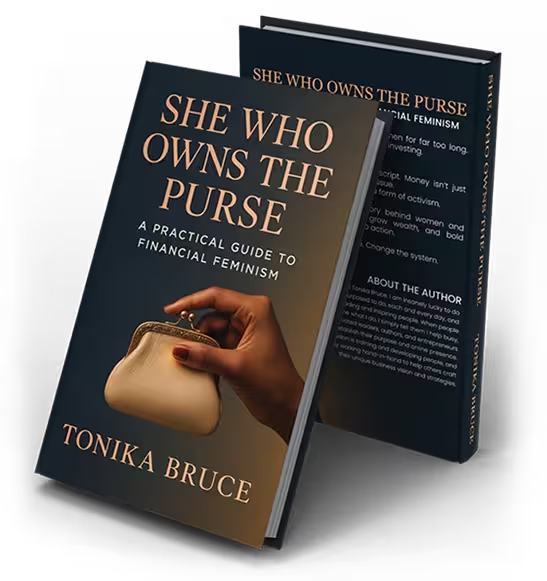
Six questions for women who are earning, working, and handling everything but still wondering what all that effort is building.
Free resources. Free community. No pretending you already know everything.
A woman recently asked me:
“Tonika, how do I make and save my first $100,000?”
It was a great question.
But before talking about how to reach $100,000, I wanted to know what she meant.
- Did she want to earn $100,000?
- Save it?
- Invest it?
- Build $100,000 in net worth?
- Create a business with meaningful value?
Those are different goals. And somewhere inside that distinction is a problem I see repeatedly among accomplished women.
We learned how to earn. Nobody necessarily taught us how to turn what we earn into something we own.
That’s a very different financial skill.
Why Can a Woman Make Good Money and Still Not Feel Financially Secure?

Because income and wealth measure different things.
Income tells you what comes in.
It does not tell you what remains.
It doesn’t reveal how much debt you carry, what you own, whether you have accessible savings, how dependent your lifestyle is on the next paycheck or whether your money is creating options for your future.
That’s why a woman can finally reach the salary she spent years pursuing and still wonder:
Why don't I feel further ahead?
I don’t think the answer is another lecture about coffee.
I think we need better questions.
Here are six.
#01
What Is Your Income Actually Building?

Start here
Your career may be doing exactly what you trained it to do.
It produces income.
But what happens after the money arrives?
Some pays for today’s life.
Of course it does.
Housing, transportation, food, insurance, children and ordinary living aren’t financial failures.
The question is whether any meaningful portion of today’s work is becoming something that remains tomorrow.
- Cash reserves.
- Retirement assets.
- Investments.
- Business equity.
- Property equity.
- Intellectual property.
- Other assets appropriate to your circumstances.
This doesn’t happen simply because your salary increases. You have to make it happen.
Your first wealth question isn't only “What do I earn?”
Ask: “What does my income leave behind?”
#02
Why Does Life Still Feel Expensive When You Earn Well?

This one confuses professional women.
- The salary says you should be comfortable.
- Your actual life says otherwise.
- Housing increased.
- Insurance increased.
- Food costs more.
- You may be supporting children while beginning to help aging parents.
- Your career itself can carry costs.
Perhaps you’re paying for convenience because demanding work leaves very little time.
And sometimes the problem is simply that your lifestyle expanded alongside your income.
None of that automatically means you’re irresponsible.
It means the numbers deserve an honest look.
A budget isn’t supposed to punish you for living.
It should show you where your money is going so you can decide whether those destinations still deserve it.
#03
How Much Does Being the Dependable Woman Cost You?
- QUICK CHECK
Which sounds most like you?
- I’m earning but not building
- Life still feels too expensive
- Everybody depends on me
- Debt keeps returning
- I need more financial safety
- I’m ready to build
FIND MY CONVERSATION
This question doesn’t appear on most financial calculators.
It should appear somewhere.
Many successful women aren’t managing only their own financial lives.
- They’re helping children.
- Parents.
- Siblings.
- Friends.
- Employees.
- Churches.
- Organizations.
Someone knows she can call you. Someone else knows you will figure it out.
Generosity can be beautiful. But invisible financial responsibility is still financial responsibility.
Ask yourself:
How much of my income is supporting obligations I never formally included in my financial plan?
You don’t need to stop caring about people.
You do need to stop pretending those responsibilities cost nothing.
#04
What Is Your Debt Trying to Tell You?

Debt is mathematical. It is not a personality diagnosis.
Before deciding what debt supposedly says about you, find out what created it.
Then ask what keeps it alive.
- Was there an emergency?
- Income interruption?
- Education?
- Medical expense?
- Lifestyle spending?
- Helping someone else?
- A business decision?
- Or does debt repeatedly return because you don’t yet have enough accessible cash to absorb ordinary surprises?
That distinction matters.
Paying a balance without understanding the underlying pattern can leave you repeating the same cycle. Inside Financial Feminism, I call this the Debt Autopsy™.
We aren’t interrogating your character. We’re looking for the cause.
#05
How Much Interruption Can Your Financial Life Absorb?

This may be the most revealing question on this page.
If your paycheck disappeared tomorrow, how long could your current life continue before you had to borrow?
A strong salary can hide a fragile system.
Everything works beautifully as long as the paycheck arrives.
- Then something changes.
- Job loss.
- Illness.
- Family emergency.
- Business slowdown.
- Burnout.
- A career transition you didn’t expect.
Suddenly the difference between earning well and being financially secure becomes visible.
Your safety net isn’t only a pile of cash.
It is the amount of distance between:
“Something happened.”
and
“Everything fell apart.”
Cash matters.
So do manageable obligations, appropriate insurance, career strength, professional relationships and knowing what your essential life actually costs.
#06
What Are You Building Now That You're Stable?
Not sure what you’re building yet?
Take the Ownership Ladder™ Assessment.
You've read enough. Pick your next move.
This gives paid traffic conversion opportunities without putting a button after every paragraph.
This brings us back to $100,000.
- Suppose your bills are being paid.
- Your career is stable.
- You’re no longer financially scrambling every month.
Good. Don’t apologize for that.
You worked for stability.
Now use it.
Ask:
What am I building because I finally have enough stability to build?
Perhaps your next milestone really is $100,000.
Define it.
“I want $100,000 in __________ because __________.”
Now you have a goal, not just a number. Your answer might be investments. Someone else’s might be retirement. Another woman wants cash available because she never wants one emergency to control her decisions again. A business owner may want to build company value.
The number doesn’t make the goal meaningful.
The reason does.
What If You Don't Know Where to Start?

This is the part I care about most.
You do not need to understand every financial concept before you begin.
You need somewhere trustworthy to go with the question.
That’s why we built the Financial Feminism Resource Hub.
You can start based on what you’re actually trying to do:
- Earn More
- Keep More
- Build More
- Own More
- Protect More
- Leave More
If you don’t even know which one applies yet, start with the Ownership Ladder™ Assessment.
It helps you identify where you are across income, savings, investments, assets, ownership, and legacy.
Then there’s Money, Explained.
Because women should not have to sit through another financial conversation pretending they understand terminology nobody ever stopped to teach them.
APR.
Asset allocation.
Vesting.
HELOC.
Net worth.
Business equity.
Expense ratio.
Legacy planning.
Look it up.
Learn it.
Then make the next decision from a stronger position.
Do You Have to Join Financial Feminism to Use the Resources?
Some Financial Feminism resources are available publicly.
Others are reserved for community members.
Financial Feminism Community membership is free.
I want that distinction to be clear because the point isn’t to trick you into a membership after you click. The point is to give women a place to continue after the article ends.
Reading is useful.
Application is better.
Which Financial Conversation Do You Need?

If you still aren’t sure where to begin, I made something specifically for you.
Financial Feminism Episode 16 brings together six conversations:
Episode 10: You’re Making Money. But Are You Building Power?
Episode 11: Your Budget Should Not Bully You: The Middle Class Is Becoming the Most Expensive Place to Live
Episode 12: Debt, Shame, and Survival: The Financial Cost of Being the Strong One
Episode 13: Debt Is Not Always a Character Flaw: What Happens When Life Costs More Than Your Plan
Episode 14: Your Safety Net Is a Power Move: What Happens If Your Paycheck Disappears Tomorrow?
Episode 15: Stability Is a Strategy: Comfort Can Cost You
Don’t listen to all six because I told you to.
Listen to Episode 16. Find the conversation that sounds like your life.
Then go deeper there.
Your Money Does Not Need to Look Impressive

It needs to work.
It should help you live.
Protect you when something changes.
Give you choices.
Allow you to build.
And eventually, if that’s important to you, give you something meaningful to leave.
Maybe your next milestone is $100,000.
Maybe it’s $10,000.
Perhaps it’s your first $1,000 that nobody gets to touch unless something truly goes wrong.
Your starting number doesn’t determine whether you belong in a conversation about ownership.
Start where you are.
Just don’t spend another five years preparing to begin.
Ready to Find Your Starting Point?
Explore the Financial Feminism Resource Hub.
Find where you are.
Choose what you need.
And if the resource you want is inside the community, come in.
Membership is free.
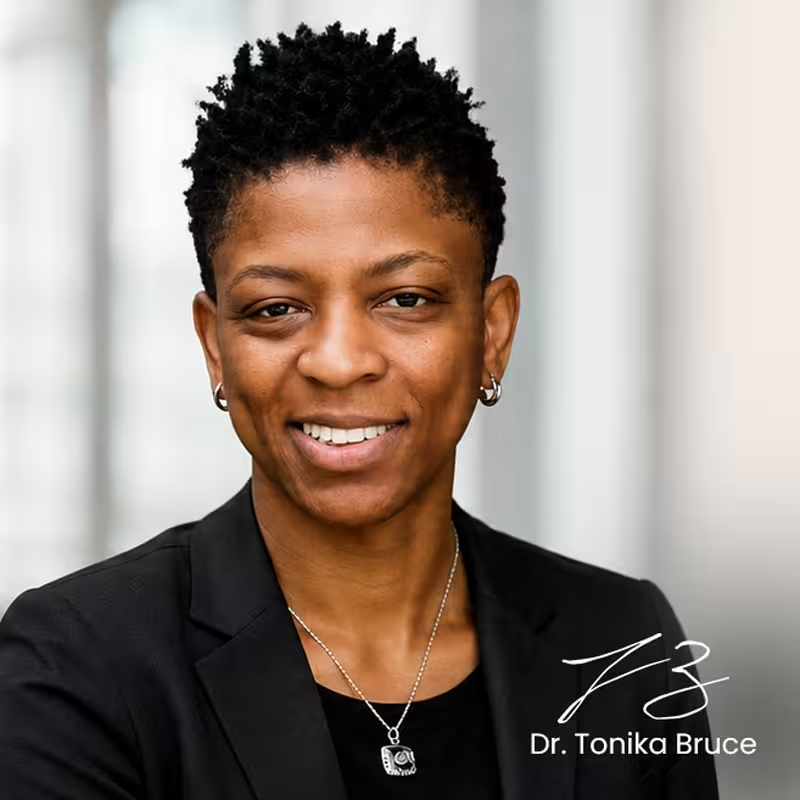
Dr. Tonika Bruce
Dr. Tonika Bruce is an entrepreneur, business strategist, leadership expert and host of Financial Feminism. Her work focuses on helping women connect income with ownership, stronger decisions and greater financial options.
Reviewed: 10/15/2026
Published: 10/21/2026